Four Opinions, One Signature: Writing B2B Copy for the People Who Actually Say Yes
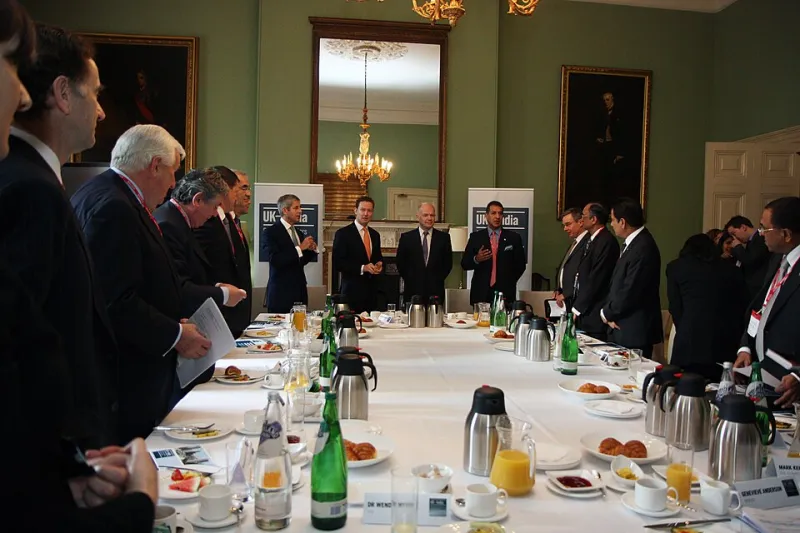
Photo: Foreign and Commonwealth Office, OGL v1.0, via Wikimedia Commons
A manufacturer I worked with described a lost deal in a single line: "They all liked it. Nobody bought it."
That's the shape of most stalled UK business-to-business sales. Not a flat no, not a rival swooping in — just a slow fizzle across a group of people who each hold a different fragment of the decision. And most B2B copy is still written as if one person reads it, start to finish, alone, with the authority to sign on the spot.
They don't. Nobody does.
Nobody buys alone
Bigger purchases in the UK tend to move through a group. A budget holder, someone from procurement, one or two people who'll actually use the thing day to day, sometimes a technical or compliance reviewer drafted in late, and a signatory who never joins a single call but reads whatever gets forwarded.
You won't meet most of them. Your copy will. So the job isn't to write for one buyer — it's to write a pack that survives being read in pieces, out of order, by people who've never spoken to you.
Each of them is quietly asking the same question in a different dialect: what could go wrong for me?
The budget holder wants to know it survives a spreadsheet
Finance doesn't fall for adjectives. They need total cost in a shape they recognise: renewal terms, what happens in year two, whether the price is per seat or per site, and whether "from £X" is a real number or a marketing hook with an asterisk doing heavy lifting.
The practical fix is a plain costs table on the page, boring rows included — onboarding, implementation, support tier, minimum term. If the price genuinely depends on scope, say what it depends on. Vagueness reads as a trap, and traps get deprioritised rather than declined, which is worse.
Procurement is paid to find the wobbly bits
Procurement isn't being difficult; they're doing the job they're measured on. They read for contradiction. If your website promises "no long-term contracts" and the order form says twenty-four months, they'll find it, and from that moment every other claim on the page is suspect.
The same applies to softer language. "Fast onboarding", "full support", "flexible pricing" — each one is a promise waiting to be tested. Give procurement the specifics that make your claims auditable: a typical implementation timeline, response times, what's included and what's charged extra. Precise language isn't defensive, it's persuasive: it tells a cautious reader you've nothing to hide.
The end user is already thinking about next March
Whoever has to use your product or service will be judged on it long after the signatory has moved on to the next thing. Their real questions are unglamorous. What does the first week look like? Who do I ring when it breaks? Will I look daft in front of my team?
Buying-group copy tends to skip this bit, because end users rarely control budget and their objections feel small. They're not small — they're the ones who'll quietly say "it's fine, but…" in a meeting you're not in. A short section on adoption, training and what happens on day ninety does more work than another paragraph about your values.
The technical reviewer arrives late and reads fast
The IT lead, the compliance officer, the person from legal — they land on your site with a checklist and fifteen minutes. Integrations, data handling, hosting, accessibility, whether anything needs a security review, which documents exist.
You can't second-guess every question, but you can make the answers findable. A single, honest, well-labelled reference page beats a hundred reassuring adjectives. If something isn't ready yet, say so and say when. A known gap is manageable; a hidden one ends the conversation.
The signatory who never joins the call
Somewhere up the chain, someone reads a forwarded email and decides. They will not read your homepage. They'll read whatever your champion has assembled — a one-pager, a proposal summary, a deck someone cobbled together at 6pm.
So build the page that travels. One screen that covers why this, what it costs, what the risks are, and what happens next. If you don't write it, someone else will, badly, from memory.
Map the risk before you write a word
Here's an exercise worth an hour of your week. List five people in a typical deal. Beside each name, write their worst-case sentence in plain English — "we sign and it never gets used", "the price doubles at renewal", "I can't get it past security". Then write the one-line answer, and make sure that answer sits within a click of the claim it supports.
If you can't write the answer, you've found something better than a copy problem: an offer or a policy that needs sorting before anyone writes another headline.
One tune, several volumes
Consistency matters more than cleverness here. Write the spine first — a single sentence of positioning, three proof points, one price statement, one next step — and then vary the volume for each reader, not the tune. Finance gets the numbers version. End users get the day-in-the-life version. Procurement gets the specifics. The signatory gets the summary.
What you can't afford is five different personalities across five pages. A buying group compares notes. The moment your site says one thing and your proposal says another, you've handed the committee a reason to wait.
Start with the risk list. The words get easier after that — and if you'd rather someone else did the mapping, that's exactly the sort of thing Fi Phillips Copywriting gets stuck into.